At CES 2026, a new generation of televisions was unveiled under bold slogans like “Meet the revolutionary new Micro RGB technology that takes TV viewing to a whole new level.” The presentations promised a breakthrough—unprecedented color, brightness, and image realism—positioning these models firmly in the ultra-premium segment.
But what actually stands behind these claims? What does Micro RGB really change in practice, and are these improvements substantial enough to justify price tags reaching tens of thousands of dollars? In this article, we take a closer look at what Micro RGB technology truly offers—and whether it delivers something genuinely new, or simply a more refined version of what we already know.
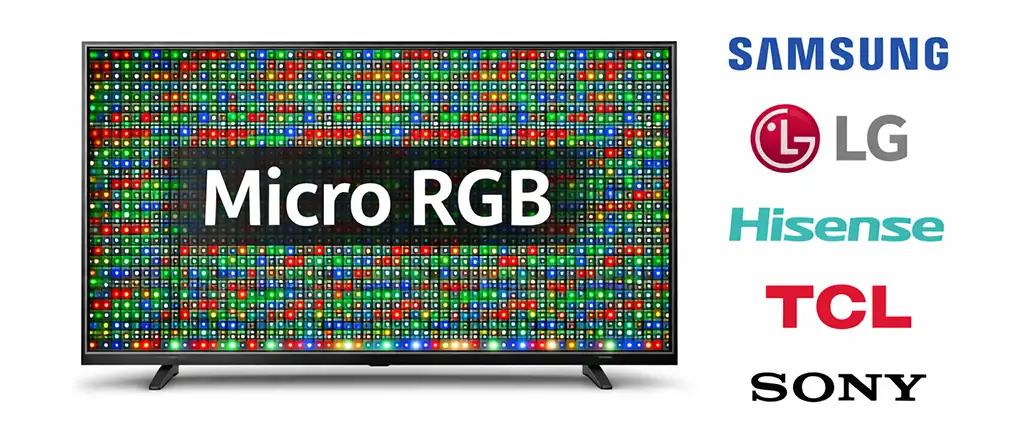
The terminology differs from one TV manufacturer to another, even though the underlying technology remains essentially the same. Samsung refers to it as Micro RGB, while LG markets its implementation under the name Micro RGB Evo. TCL uses the terms Mini RGB or RGB Mini-LED, and Hisense also describes its solution as RGB Mini-LED and RGB Mini LED evo. Sony, in turn, takes a more reserved approach, simply calling the technology RGB LED.
The emergence of Micro LED backlighting
Micro LED backlighting is the result of the continued evolution of TV backlight technologies and can be described as the fifth stage in this development. The first generation used cold cathode fluorescent lamps (CCFL). This was followed by LED Edge backlighting, then Direct LED. Later, Dual LED systems appeared, adding a blue LED to the backlight. Mini LED technology came next, replacing larger LEDs with smaller ones to increase the number of light sources and improve brightness control. Micro LED backlighting is the next step, using three separate LEDs—red, green, and blue.
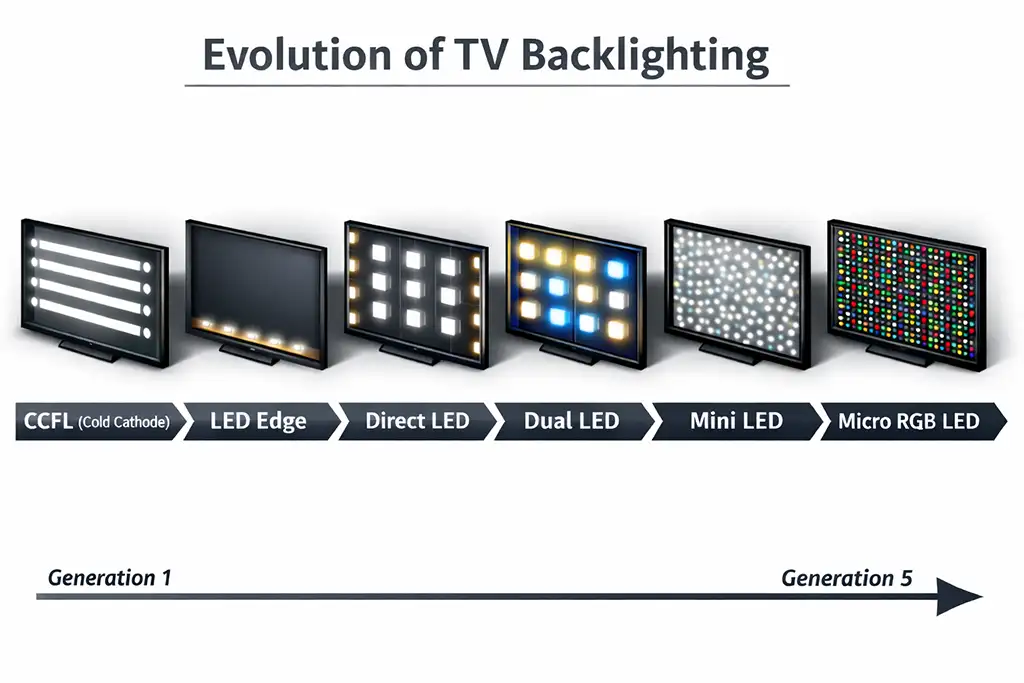
In parallel with this technical evolution, the structure of the TV panel industry changed. Samsung, LG, and Panasonic exited the production of LED TV panels. Panasonic did so mainly due to financial difficulties, while Samsung and LG discontinued the development and production of LED panels after concluding that this direction was no longer profitable. Their LED panel businesses were sold to Chinese companies, and both manufacturers shifted their focus to OLED panel development.
Chinese panel makers, which do not have a leading position in OLED technology, continued working with LED panels. As a result, companies such as TCL, which acquired parts of Samsung’s former panel business, and Hisense began focusing on further improvements to LED panel technology, leading to the development of solutions such as Micro LED backlighting.
Features of Micro LED technology
An LED display works in a fairly simple way: a backlight illuminates the pixels, and each pixel consists of liquid crystals that rotate when a certain voltage is applied. By changing their position, the liquid crystals control how much light passes through and form the image.
Previously, the backlight did not play a significant role in color reproduction. The main role was assigned to the pixels themselves, and image quality depended on how well they could filter the required part of the spectrum. High-quality QLED panels, for example, can reproduce about one billion colors with a 10-bit color depth.
With the development of Micro LED technology, this approach changed. The goal was to reduce the influence of the pixels on final image quality by making the backlight itself colored: red light for red pixels, blue light for blue pixels, and green light for green pixels. This makes it possible to achieve higher image quality on LED panels and allows the production of LED displays with a true 10-bit color depth.
The future of Micro LED technology
In my view, this technology has limited prospects. The manufacturing process for such panels is extremely complex, which directly affects their cost. In 2025, Hisense began selling 115-inch (116-inch) displays, and toward the end of the year both Hisense and Samsung started offering Micro LED televisions. However, their prices remain very high, typically in the range of $25,000–30,000, which is difficult to justify for most buyers.
For comparison, LG offers a 97-inch OLED TV at around $25,000, while an 83-inch OLED model can be purchased for about $5,500. In this context, paying an additional $20,000 for a relatively small increase in screen size looks unreasonable.
At the same time, the situation could change if panel manufacturers manage to significantly reduce production costs. At a more realistic price level, such televisions could find their audience. There are also plans to begin producing Micro LED panels starting from 55 inches. These smaller sizes should be noticeably cheaper, since larger screens dramatically increase production complexity and the number of defective panels.