Micro RGB AI Engine Pro Processor — This processor is used in Samsung TVs with Micro RGB displays in 2026. However, it’s important to understand that this is a marketing name for the processor and has no connection to the actual processor used in the TV.
About 15 years ago, when “smart” TVs first appeared, an agreement was reached between processor manufacturers and TV manufacturers that gave TV brand owners the right to register their own commercial names for processors, as well as to register commercial names for technologies (software) implemented in the processors, such as upscaling (4K AI Upscaling Pro), a program for improving the processing of moving objects (AI Motion Enhancer Pro), a program for processing HDR metadata (Auto HDR Remastering Pro), and many others. Such programs are standard and are implemented at the processor level during its manufacture.
What processor is behind the name Micro RGB AI Engine Pro?
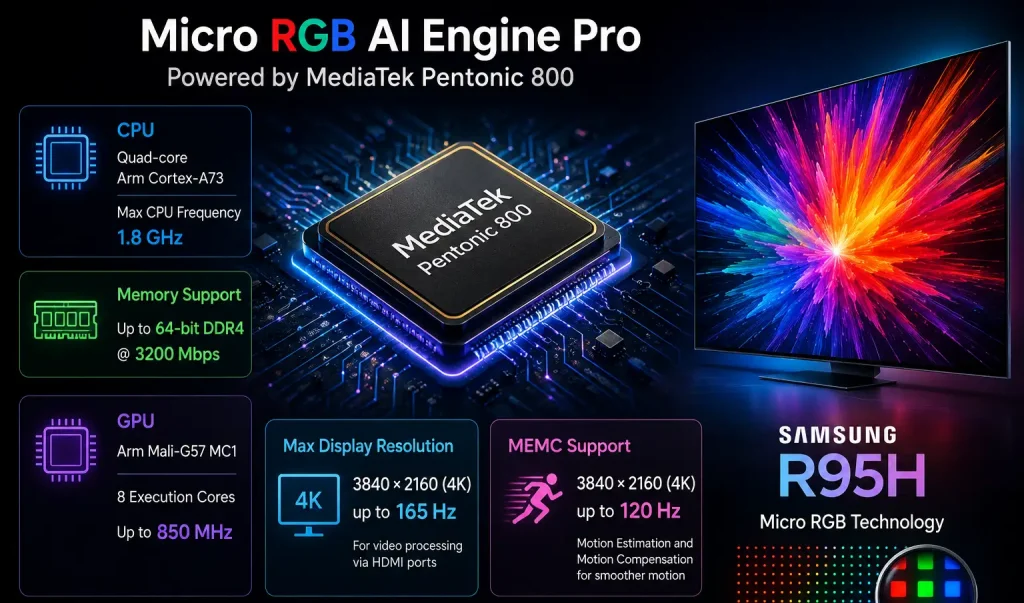
In reality, the Micro RGB AI Engine Pro is a processor manufactured by MediaTek, the world’s leading supplier of television processors. Samsung’s R95H TVs are equipped with the MediaTek Pentonic 800 chip, which has the following key specifications:
- CPU: Quad-core Arm Cortex-A73
- Maximum CPU frequency: 1.8 GHz
- Memory support: Up to 64-bit DDR4 @ 3200 Mbps
- GPU: Arm Mali-G57 MC1
- Maximum display resolution: 3840 × 2160 (4K) at up to 165 Hz
- MEMC (Motion Estimation and Motion Compensation): 3840 × 2160 (4K) at up to 120 Hz
The processor uses four Arm Cortex-A73 CPU cores, an architecture introduced in 2016, with a maximum clock speed of 1.8 GHz. Its memory controller supports 64-bit DDR4 memory operating at up to 3200 Mbps.
Graphics processing is handled by the Arm Mali-G57 MC1 GPU, which contains eight execution cores running at up to 850 MHz. It supports a maximum display resolution of 3840 × 2160 (4K) with refresh rates of up to 165 Hz for for processing video via HDMI ports.
The processor also supports MEMC (Motion Estimation and Compensation) technology at a resolution of 3840 × 2160 (4K) and frame rates of up to 120 frames per second. MEMC is a motion interpolation technology that generates additional frames to ensure smoother motion. The specification “120 frames per second” refers to the processor’s internal video processing capabilities; that is, the processor can only process video at a frequency of up to 120 Hz. When receiving a video signal via HDMI at a frame rate higher than 120 frames per second, the video stream is not further processed by the processor but is transmitted to the display in its original form.
Micro RGB Backlighting
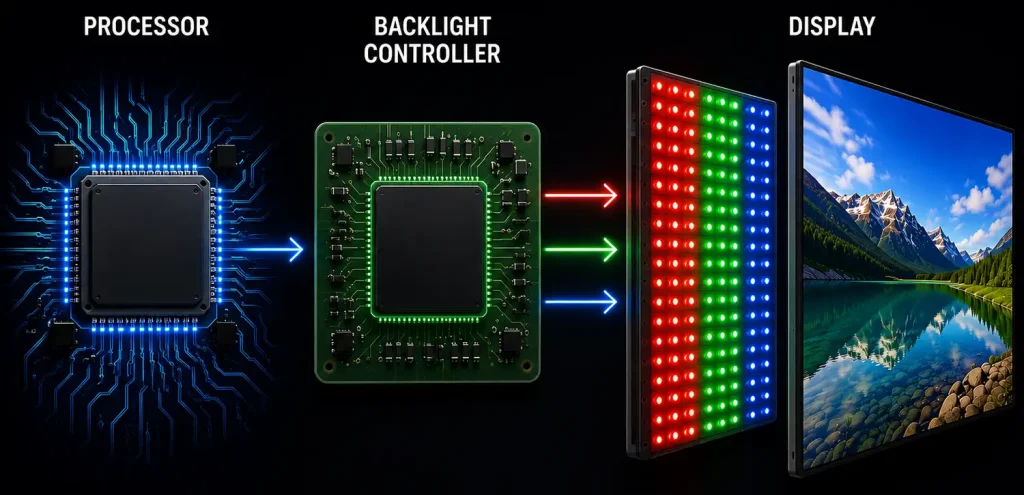
Although Samsung positions the processor as a key component of its Micro RGB technology, this is not entirely accurate, since the same processor is used in many other Samsung TV series. The processor does not control the RGB LEDs directly. Instead, its primary role is to process the video signal and generate the data required by the backlight control system.
The processor analyzes each video frame, determines the optimal brightness and color for different areas of the screen, and identifies areas where the backlight can be dimmed or turned off completely. These parameters are then transmitted to the backlight control system. The LED driver/backlight controller receives this data and adjusts the current supplied to the red, green, and blue backlight LEDs.
In other words, the processor determines which areas of the image can be improved by adjusting the backlight. It also determines where a specific color channel can be turned off. For example, when displaying a blue sky, the red and green LEDs can be turned off, while the blue LEDs remain active. This allows the LCD panel to block less unwanted light and improves both contrast and color efficiency.
However, this likely does not occur at the level of individual LEDs but is applied to backlight zones as a whole. Samsung has not disclosed the exact architecture of the Micro RGB backlight, so it can be assumed that the RGB LEDs are grouped into independently controllable zones rather than being controlled individually.