After acquiring the LED panel manufacturing business from Korean companies, TCL began investing in various display technologies. One of these technologies was DLG, introduced in 2022 and widely adopted in TVs starting in 2025–2026.
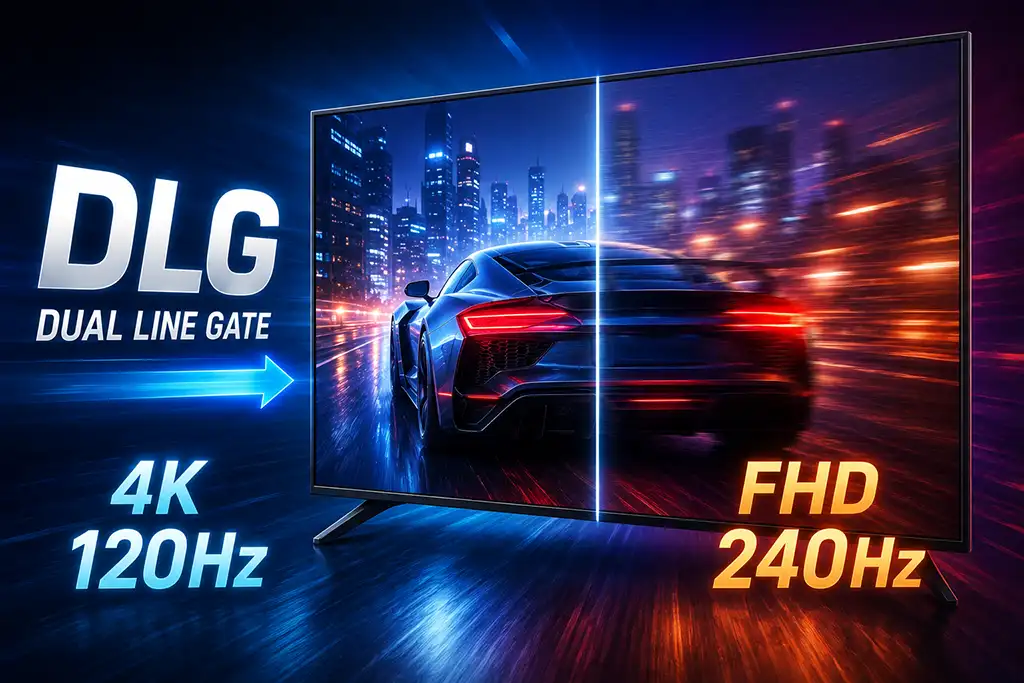
According to the advertising, the technology allows the TV’s refresh rate to be doubled exactly—from 60 Hz to 120 Hz on 60 Hz displays and from 120 Hz to 240 Hz on 120 Hz displays. In reality, however, this claim is quite controversial and requires further explanation.
How DLG Works
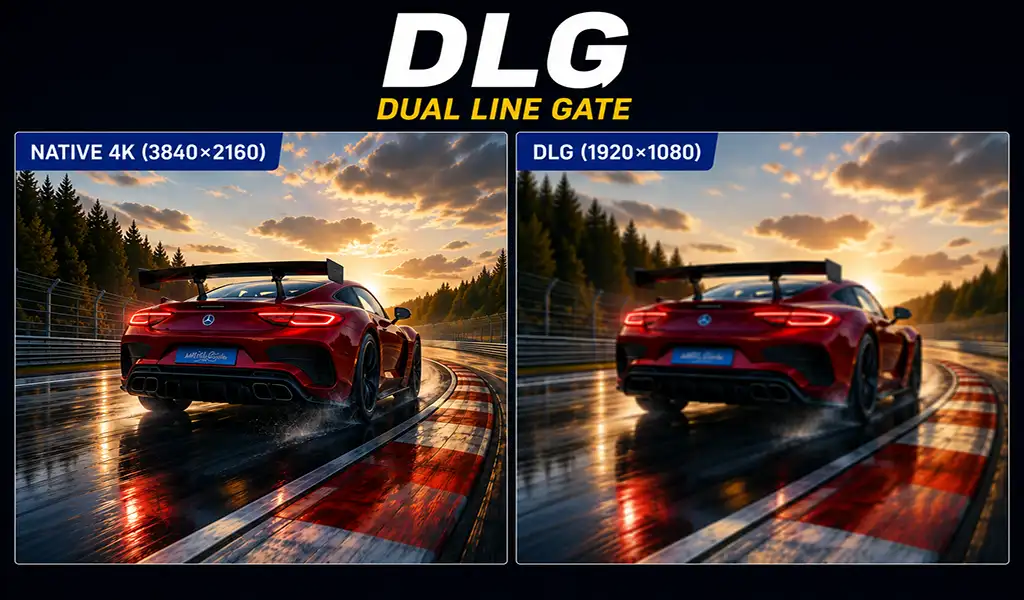
The technology works by reducing the image resolution. If you have a 4K (UHD) TV, its resolution is 3840 × 2160 pixels. The DLG principle is based on doubling lines, where one line is skipped and the previous one is repeated. In other words, the number of pixels used to create the image is reduced both horizontally and vertically.
As a result, when DLG mode is enabled, the TV stops displaying the image in 4K format. The resolution is reduced to 1920 × 1080 pixels, and the TV switches to Full HD mode. In other words, the image is rendered using only a quarter of the original 4K pixel count.
The main purpose of this technology is to reduce the amount of data processed by the display system. Since the T-Con (timing controller) board is responsible for processing and transmitting image data to the display panel, lowering the resolution reduces the load on the board.
The TV effectively reduces image quality by a factor of four compared to the original 4K resolution, since fewer pixels are used to form the image.
DLG and Refresh Rate Boost
In this case, the refresh rate is not actually increased at the display panel level. Instead, DLG allows the TV to receive and process a higher-frequency video signal by reducing the amount of data transferred from the processor to the T-Con board through the HDMI input.
TV processors have a maximum supported refresh rate depending on the selected resolution. For example, a processor may support a maximum of 165 Hz at UHD resolution, while at Full HD resolution it can operate at 240 Hz. This means that the display system itself cannot process a native UHD signal at 240 Hz.
Let’s look at an example. Suppose you set a game console to output a signal of 3840 × 2160 pixels at 240 Hz. If the TV does not support this format, you will either see a black screen or receive a message indicating that the TV cannot accept this signal.
However, if the TV supports DLG and the function is enabled, the processor sends a modified video stream to the T-Con board. During this process, some lines of the image are skipped—for example, even-numbered lines—while the remaining lines are duplicated to replace them. The processor converts the UHD signal to Full HD using a simplified conversion method without performing traditional downscaling.
Simply put, the processor has to perform significantly fewer calculations, while the T-Con board receives and processes a much smaller amount of image data. The board then uses this reduced data stream to display the image across the entire UHD panel area.
From the user’s point of view, especially in gaming, DLG represents a compromise. The image loses some detail because it is no longer displayed at the full native 4K resolution, but the higher refresh rate provides smoother motion and can improve the gaming experience.