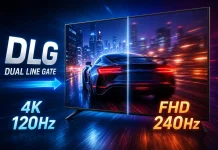
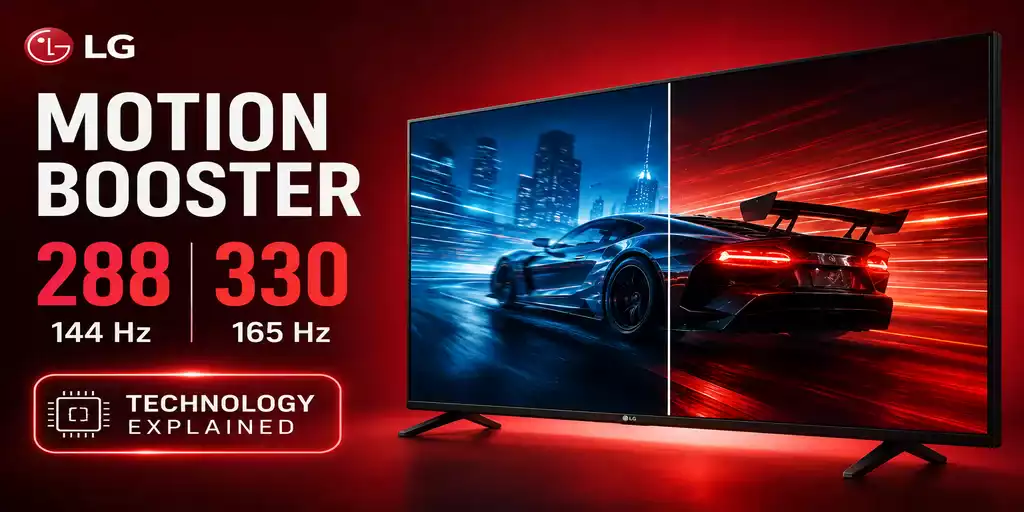
Motion Booster 288 and Motion Booster 330 are marketing names used by LG for displays based on DLG (Dual Line Gate) technology. The technology itself is not exclusive to LG; it is implemented by LED panel manufacturers.
Motion Booster 288 is used for LG TVs with a 144 Hz refresh rate, while Motion Booster 330 refers to models supporting a 165 Hz refresh rate.
The Motion Booster 240 designation is not used because there is no practical need for a separate marketing name for this refresh rate.
How Motion Booster Works
Motion Booster technology works by reducing the image resolution. If you have a 4K (UHD) TV, its resolution is 3840 × 2160 pixels. Motion Booster works by doubling the lines, skipping one line and repeating the previous one. In other words, the number of pixels used to create the image is reduced both horizontally and vertically.
As a result, when Motion Booster mode is enabled, the TV no longer displays the image in 4K. The resolution is reduced to 1920 × 1080 pixels, and the TV essentially becomes a Full HD TV.
The main purpose of Motion Booster technology is to enable video transmission—typically gaming content—to the TV at a refresh rate of 144 or 165 Hz without additional image processing, resulting in minimal input lag.
The T-Con (timing controller) board is responsible for processing and transmitting image data to the display panel. However, it cannot always support such a high refresh rate in UHD mode, mainly because of the controller’s bandwidth limitations.
For example, you can set a gaming console or graphics card to output Full HD at 165 Hz. However, because the TV has a 4K panel, it must scale the image before displaying it. This increases the amount of data that needs to be processed by the TV’s processor and T-Con board. If the TV receives a 4K signal with a refresh rate of 165 Hz, the processor does not need to scale the image; it simply needs to receive the signal and pass it on to the display. However, in this mode, the amount of data transmitted from the processor to the display increases significantly, which can cause a delay in image output.
Motion Booster solves this problem differently. A 4K signal at 165 Hz is received through the HDMI port and processed by the TV’s processor. When the image is transmitted to the display, some lines are removed while others are duplicated—for example, even lines may be skipped while odd lines are duplicated at the T-Con level. This significantly reduces the data stream and eliminates the need for additional scaling.
By reducing the amount of data that needs to be processed, Motion Booster significantly shortens image processing time and allows the TV to maintain a 144 Hz or 165 Hz refresh rate with minimal input lag. The trade-off is that the actual image resolution is reduced to Full HD, although the image continues to be displayed across the entire 4K screen.
Motion Booster 288 and Motion Booster 330, what these numbers mean
Now let’s take a closer look at the numbers 288 and 330. It is easy to see that they correspond to twice the TV’s refresh rate when receiving a signal through the HDMI port from a gaming console or other compatible device.
However, these numbers do not represent an actual refresh rate, frequency, or any other physical parameter. They are simply marketing designations used by LG.
The reason the refresh rate is effectively doubled in the name is purely marketing. A higher number can subconsciously suggest better performance or more advanced technology, making Motion Booster 330 appear more advanced than Motion Booster 288, even though the numbers themselves do not describe a specific technical characteristic.