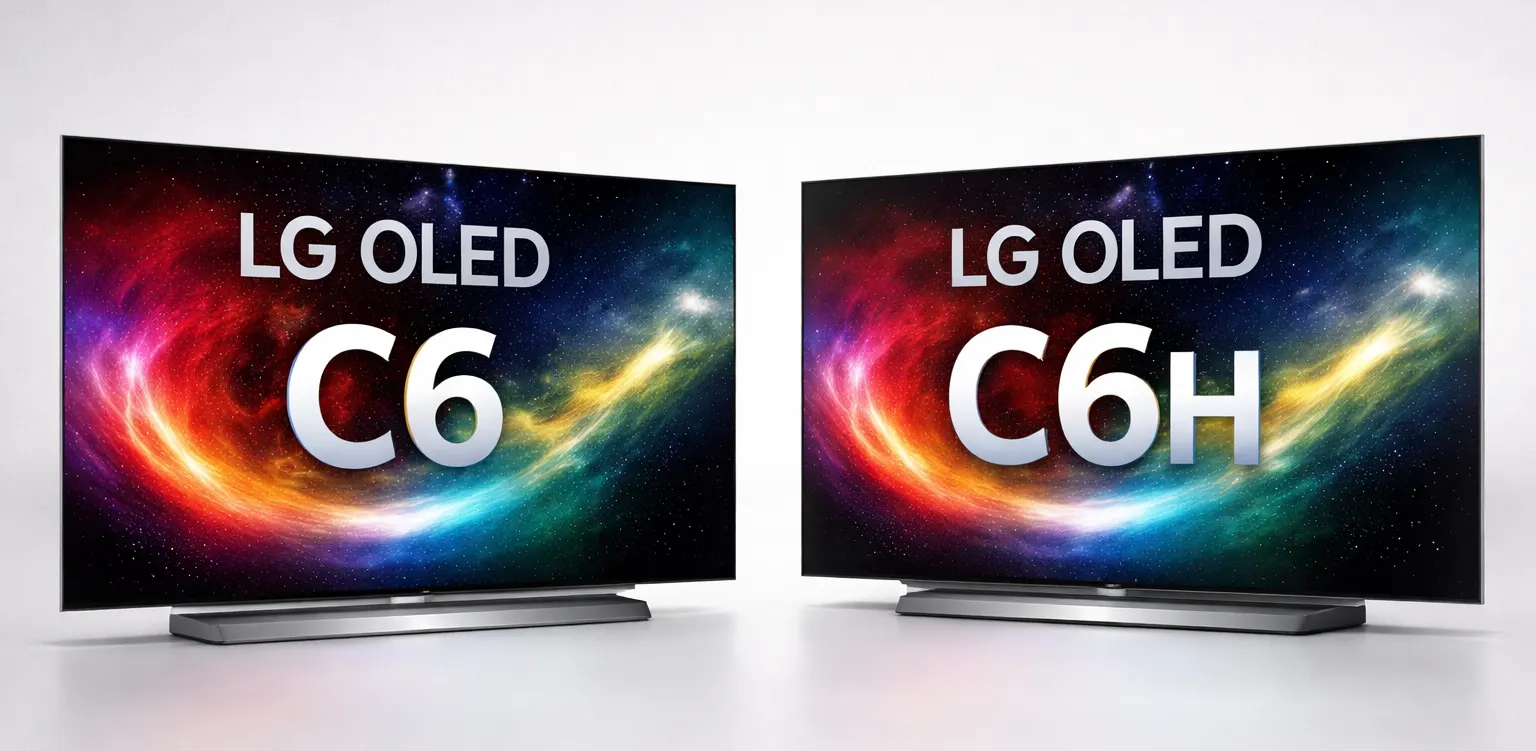
LG Electronics has unveiled part of its 2026 OLED TV lineup, including the C6 series. Several models are available, and it’s important to understand how they are grouped.
Below are the two C6 model groups presented in a single table:
LG OLED C6 Models (2026)
| First Series | Second Series |
|---|---|
| OLED48C6AUA | OLED42C6PUA |
| OLED55C6AUA | OLED48C6PUA |
| OLED65C6AUA | OLED55C6PUA |
| OLED77C6HUA | OLED65C6PUA |
| OLED83C6HUA | OLED77C6HUP |
| OLED83C6HUP |
Differences Between AUA, HUA and PUA, HUP
When comparing the two groups of LG Electronics C6 TVs, the main technical difference lies in their wireless connectivity.
Models from the first series (AUA, HUA) are equipped with Wi-Fi 6E modules, while the second series (PUA, HUP) use Wi-Fi 5.
In practical terms, this difference is far less significant than it may seem. Wi-Fi 5 is capable of delivering speeds of up to 6 Gbps, whereas Wi-Fi 6E can theoretically reach up to 10 Gbps. While this is a noticeable increase on paper, such speeds are generally excessive for typical home use.
More importantly, your actual experience depends on your internet provider. For example, if your home connection is limited to 1–2 Gbps, the advantages of Wi-Fi 6E will not be noticeable in everyday use.
The only real distinction is that Wi-Fi 6E operates on the newer 6 GHz frequency band, which is typically less congested. However, in many real-world scenarios—especially in private homes—even the traditional frequency bands used by Wi-Fi 5 are not heavily crowded.
In short, while Wi-Fi 6E is technically more advanced, the difference for most users will be minimal.
The second series represents the standard TV lineup and is typically sold through regular retail channels. In contrast, the first series is usually supplied to major retailers under exclusive sales agreements.
Additionally, the 77-inch and 83-inch models are designated as C6H. This reflects a design change, primarily related to the TV stand, as larger screen sizes require a slightly different construction to ensure proper stability.