In 2025, Samsung introduced around 25 monitor models. This is standard practice, as monitors are not the company’s main priority and most models stay on the market for several years. This article offers a brief overview of the monitors and their key features to help with choosing the right model.
Samsung follows a long-established approach, releasing only a limited number of monitor types. Most of these are refreshed or rebranded versions of models from previous years. At this point, it is difficult to introduce anything truly new, and the promoted AI features are largely marketing additions rather than real innovations.
Samsung’s lineup includes conventional monitors, FG series monitors, and models with the built-in Tizen FM operating system.
3D monitors stand apart as a separate category. They originated from Hisense, which acquired Toshiba’s visualization division and continued the company’s 2013 development of glasses-free 3D TVs. This resulted in a display that uses a lens system to create a three-dimensional image. Several brands now use similar panels in their monitors, but these models have significant limitations. 3D mode works only in certain games, overall image quality is average, color reproduction is weak, 3D rendering errors occur, and the price is around $1,000, which is hard to justify.
All other monitors use either 8-bit panels with FRC or OLED displays. The FG50 model is an exception, featuring an 8-bit panel without FRC.
List of Samsung monitors for 2025
| Model | Model Alias | Comments / Series / Notes |
|---|---|---|
| S49F950U | 49″ ViewFinity S9 S95UF LS49F950UAUXEN LS49F950UAEXXY LS49F950U S49F950UA | 8-bit display (8bit+FRC), mid-level monitor |
| S49FG91 | 49″ Odyssey G91F S49FG910 S49FG912 LS49FG910EUXEN LS49FG910ENXZA LS49FG912EEXXS LS49FG910EMXUE | 8-bit display (8bit+FRC), mid-level monitor |
| S27FG900X | 27″ Odyssey 3D G90XF LS27FG900XNXZA | 8-bit IPS 3D display (8bit+FRC), entry-level monitor |
| S27FG810, S26FG810 | 27″ Odyssey OLED G81SF UHD 240Hz S27FG812S LS27FG810SNXZA LS27FG812SCXXF | 10 bit High-end OLED monitor |
| S40FG75, S37FG75 | 37″ Samsung Odyssey G7 G75F WUHD 165Hz LS40FG75DENXZA LS40FG750EUXEN 40″ Samsung Odyssey G7 G75F WUHD 180Hz LS37FG75DENXZA | 8-bit display (8bit+FRC), mid-level monitor |
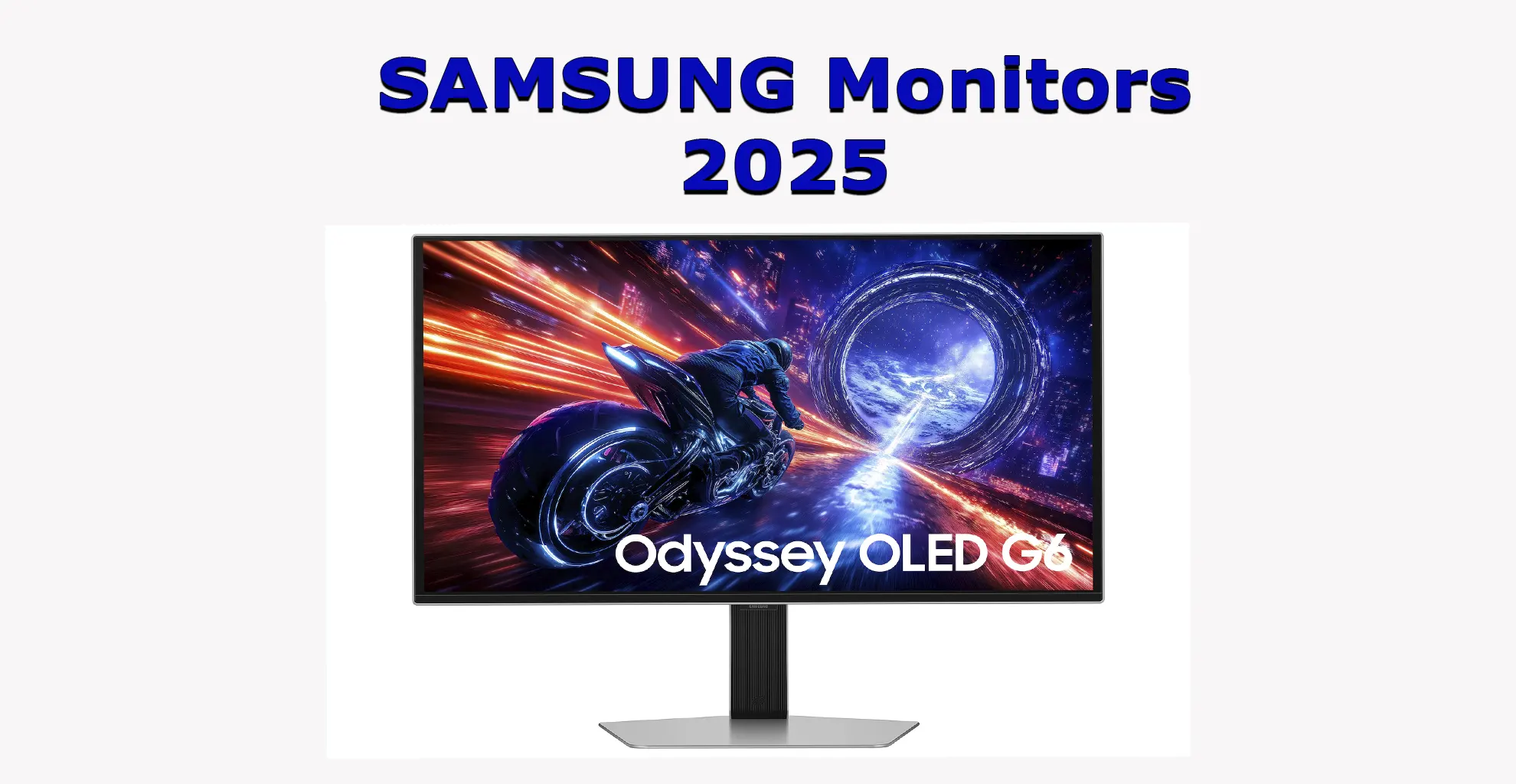
| S27FG602S | 27” Odyssey OLED G6 G60SF QHD 500Hz S27FG600S LS27FG602SEXXS LS27FG602SNXZA LS27FG602SUXEN LS27FG600SUXEN | 10 bit High-end OLED monitor |
| S32FG50, S27FG50 | LS32FG50 LS32FG500 LS32FG500E LS32FG500EN LS27FG50 LS27FG500 LS327FG500E LS27FG500EN | 8-bit panel IPS, entry-level monitor |
| S27FG502S | 27″ Odyssey OLED G5 G50SF QHD 180Hz S27FG502S LS27FG500SUXEN LS27FG500SNXZA LS27FG502SEXXS | 10 bit High-end OLED monitor |
| S32FG51, S27FG51 | LS27FG51 LS27FG510 LS27FG510E LS32FG51 LS32FG510 LS32FG510E | 8-bit panel VA, entry-level monitor |
| S32FM90 | LS32FM902S S27FM902S M90SF LS32FM90 32″ M90SF UHD Smart Monitor M9 | 10 bit High-end OLED monitor |
| S32FM80 | LS32FM803U S27FM803U M80F LS32FM80 32″ M80F UHD Smart Monitor M8 | 8-bit display (8bit+FRC), entry-level monitor |
| S43FM70, S32FM70 | S43FM702U S32FM702U LS43FM702U LS32FM702U 43″ M70F UHD Smart Monitor M7 32″ M70F UHD Smart Monitor M7 | 8-bit panel (8bit+FRC), entry-level monitor |
The Samsung S49F950U is a 49-inch ultra-wide curved monitor with a 5120×1440 resolution and a 32:9 aspect ratio, essentially replacing a dual-QHD setup in a single screen. It uses a VA panel with 8-bit color depth and FRC, allowing it to display about a billion colors. The monitor supports HDR10+ and covers around 115% of the sRGB and about 92% of the DCI-P3 gamut, which means its color performance is quite modest. It offers a refresh rate of up to 120 Hz and a response time of roughly 5 ms.
Connectivity features include USB-C with DisplayPort Alt Mode and up to 90 W power delivery, multiple USB ports, HDMI 2.0, DisplayPort 1.4, and an audio output. Additional functions include built-in speakers, Picture-in-Picture, Picture-by-Picture, and automatic source switching. Overall, this is a mid-range monitor with modest image quality.
The Samsung S49FG91 is a 49-inch curved gaming monitor from the Odyssey G9 series with a 5120×1440 resolution and a 32:9 aspect ratio. It features a VA panel with 8-bit color depth and support for 8 bit + FRC, providing about 92% DCI-P3 coverage. The monitor supports HDR10+ and HDR10, offers a refresh rate from 48 to 144 Hz, and has a 1 ms response time.
It comes with two HDMI 2.1 ports, a DisplayPort 1.4, a USB hub (USB-B and two USB-A), an audio output, and supports HDCP 2.2.
A mid-range monitor with a large screen.
The Samsung SFM70 monitor comes in two sizes, 43 and 32 inches, both with a 3840×2160 resolution. It is an entry-level model with Tizen OS, and in many ways it can be considered more of a TV than a monitor. The panel is 8-bit with support for 8-bit + FRC. The refresh rate is 60 Hz, which clearly places it in the entry-level segment. The NTSC color gamut is about 72%, which is a rather modest specification.
The model runs on the Tizen platform with the One UI shell, so it supports Smart functions and can be used independently without a computer. Sound is provided by built-in 2×10 W stereo speakers with Adaptive Sound+ and Active Voice Amplifier technologies.
Connections include USB-C (for data transfer, video output, and charging up to 65 W), three USB-A 2.0 ports, two HDMI 2.0 ports with CEC support, as well as Wi-Fi and Bluetooth 5.2 modules.
The Samsung S40FG75 and Samsung S37FG75 are high-resolution VA monitors with similar characteristics, differing mainly in screen size and resolution. The S40FG75 is equipped with a 39.6-inch curved panel at 5120×2160, while the S37FG75 features a 36.5-inch curved panel with a 3840×2160 resolution. Both use VA panels with 8-bit color depth and 8-bit + FRC support, offering 99% sRGB coverage, which is a modest indicator for this class.
The S40FG75 reaches a refresh rate of 48–180 Hz, and the S37FG75 supports 48–165 Hz. Both models offer HDR10, HDR10+, and HDR10+ Gaming, though it is important to note that 8-bit panels do not meet HDR requirements and are effectively unable to display true HDR content.
Connectivity is identical on both models, including two HDMI 2.1 ports, DisplayPort 1.4, a USB-B upstream port, two USB-A downstream ports, a 3.5 mm audio output, and HDCP 2.2 support. Overall, these are mid-range monitors primarily oriented toward gaming.
The Samsung S32FG50 and S27FG50 are IPS monitors with a 2560×1440 resolution and a standard 16:9 aspect ratio. They use an 8-bit panel with a refresh rate ranging from 48 to 180 Hz. HDR10 support is listed, but true HDR cannot be displayed on 8-bit panels.
The monitors are equipped with one HDMI 2.0 port, one DisplayPort 1.2, and a 3.5 mm audio output. Overall, these models are updated versions of monitors released 5–7 years ago and represent a budget option with minimal specifications.
The Samsung S27FG51 and S32FG51 are G5-series monitors equipped with VA panels, a 2560×1440 resolution, and an 8-bit display without FRC. They feature two HDMI 2.0 ports, one DisplayPort 1.4, a USB-A 2.0 port, and a 3.5 mm audio output. Essentially, these models are refreshed versions of older monitors from previous generations, reintroduced in 2025 with minimal updates.
The Samsung S32FM90 is a 31.5-inch 4K QD-OLED monitor built around a true 10-bit panel. It supports a 48–165 Hz refresh rate and delivers an exceptionally fast 0.03 ms response time. For connectivity, it includes HDMI 2.1, DisplayPort 1.4, two USB-A ports, and a USB-C port with 90 W power delivery and DisplayPort Alt Mode. The monitor also supports a built-in 4K camera with integrated microphones.
Powered by Tizen with One UI, it offers full smart TV functionality, allowing you to use it on its own to stream videos and access apps without needing a computer.
The Samsung S32FM80 is a 31.5-inch Smart Monitor built on a VA panel with a resolution of 3840×2160. It uses an 8-bit panel with FRC to enhance color depth. The monitor supports HDR10 and HDR10+, though only within a very limited range, and features a modest 60 Hz refresh rate.
Connectivity includes HDMI 2.0, USB-C with 65 W power delivery and DisplayPort Alt Mode, and two USB-A ports. Powered by the Tizen operating system with One UI, the monitor can function as an independent device. It also comes with a removable SlimFit camera (2560×1440) with a privacy shutter for video calls through Google Meet and other apps.
Overall, the Samsung S32FM80 is a smart monitor with basic technical capabilities.
The Samsung S27FG502s is a 27-inch QD-OLED monitor with a 2560×1440 resolution and a 16:9 aspect ratio. It uses a true 10-bit panel without FRC, capable of producing 1.07 billion colors. The refresh rate ranges from 48 to 180 Hz, with up to 144 Hz available through HDMI. For connectivity, the monitor includes one HDMI 2.0 port, one DisplayPort 1.2, and a 3.5 mm audio output.
Overall, the S27FG502 is a premium OLED gaming monitor that offers outstanding contrast and excellent image quality.
The Samsung S27FG900X is a 27-inch 4K IPS monitor that uses an 8-bit + FRC panel and supports a refresh rate of 48–165 Hz. It offers HDR10 and HDR10+ Gaming compatibility, though HDR performance is limited due to the panel’s color depth. The connectivity options include two HDMI 2.1 ports, a DisplayPort 1.4 connector, a USB-B upstream port, two USB-A downstream ports, and built-in 5 W stereo speakers. A notable feature of this model is its ability to display 3D content using a lens system and eye-tracking technology, delivering 2K resolution per eye in 3D mode without the need for glasses.
The Samsung Odyssey OLED G8 is a high-end 4K gaming monitor built around a QD-OLED panel with a resolution of 3840×2160 and a standard 16:9 aspect ratio. Its true 10-bit panel without FRC delivers over one billion colors, 99% DCI-P3 coverage, and outstanding contrast with deep blacks.
The monitor supports a wide refresh rate range from 48 to 240 Hz, ensuring exceptionally smooth motion. HDR capabilities include HDR10, HDR10+, and HDR10+ Gaming, with peak brightness reaching up to 1000 cd/m² in HDR content. Connectivity is modern and flexible, featuring two HDMI 2.1 ports, DisplayPort 1.4, a USB-B upstream port, two USB-A ports, and a 3.5 mm audio output. The Odyssey OLED G8 also supports AMD FreeSync Premium Pro and is compatible with NVIDIA G-Sync.